A parent turning over their child is putting enormous trust in you. They hardly ever claim it out loud, yet the underlying inquiry is constantly the exact same: if something goes wrong, will certainly you understand what to do in the initial 2 minutes?
That is the genuine purpose of childcare first aid training. Not a certificate on the wall surface, not one more tick in a conformity spreadsheet, but the confidence to act rapidly, steadly and correctly when a kid's life or long‑term health relies on your next decision.
Express child care first aid courses and fast CPR refresher training aim to supply this competence on a limited schedule. Done well, they work. Done terribly, they provide a false sense of security. The distinction lies in the quality of the training, how honestly it mirrors reality with children, and whether it prepares you to think, not just to pass a test.
I have instructed first aid and CPR training to nursery teams, childminders, sports instructors, foster carers and moms and dads for several years. The pattern is consistent: emergencies with kids seldom resemble the circumstance cards. They are noisier, messier, even more complicated and even more emotional. The right first aid course prepares for that.
This overview undergoes what every carer ought to really be able to do after express childcare first aid training, cpr training Caboolture exactly how express first aid and CPR courses are structured, and what to search for when choosing a fast first aid course near you.
Why youngster first aid is various from grown-up initial aid
Many individuals get to first aid and CPR training thinking, "I did a first aid course at the workplace a few years ago; surely that covers kids also." It does not, a minimum of not adequately.
Children are not simply smaller adults. Their respiratory tracts, breathing patterns, physiology and emotional responses are different, and one of the most typical emergency situations are various too.
A couple of instances that constantly stick out in course:
- Infants and young children choke even more frequently than grownups, commonly silently. Breathing troubles, particularly bronchial asthma and viral wheeze, dominate many child care emergencies. Allergic responses can intensify from light breakouts to life‑threatening anaphylaxis in minutes. Head injuries in youngsters are very usual, but identifying when to fret is nuanced. Cardiac apprehension in youngsters is much much less common, yet when it happens, it is generally secondary to breathing problems or injury, not a key heart issue.
An express childcare first aid course needs to recognize these distinctions. A common fast first aid course that only skims child‑specific issues may be fine for office team that see children periodically, however except early years specialists, childminders or after‑school club leaders.
If you take care of youngsters on a regular basis, you require first aid training that spends severe time on paediatric situations, not just a quick add‑on at the end of an adult course.

What "express" childcare first aid training must still cover
"Express" or "fast" in this context ought to explain the way the course is supplied, not the depth of crucial content. The moment savings generally come from combined learning, tighter routines and concentrated mentor, not from reducing important topics.
At an outright minimum, express child care first aid courses for carers should leave you positive with:
Assessing a youngster promptly and securely Managing a less competent child Paediatric CPR and use of an AED Choking in infants and youngsters Breathing problems and bronchial asthma strikesIf a company is advertising an express childcare first aid course that does not plainly include all of these, treat that as a warning sign. Additional fundamentals like bleeding control, burns, allergies, seizures and head injuries need to additionally feature, yet those 5 things are non‑negotiable.
When centres promote fast first aid courses or express first aid training, ask directly how much time is invested in paediatric scenarios, hands‑on CPR practice and choking drills. Genuine skill requires rep and feedback, and you can not press that endlessly without losing quality.
The core skills every childcare carer have to really master
Not every first aid certificate shows true capability. The goal is not simply to endure first aid training, but to leave able to carry out particular abilities under pressure.
Rapid assessment: reviewing the situation in seconds
The first point an excellent express first aid course instructs is not a plaster method, however how to come close to any kind of incident without cold. The mental sequence you wish to internalise goes something such as this:
First, look for danger to you, the youngster and others. Childcare occurrences typically happen in playgrounds, on steps, near warm beverages or in parking lot. If you rush straight in, you run the risk of adding a second casualty.
Second, get a fast first impression. Is the kid awake? Breathing? Making noise? Relocating usually? Colour regular or pale/blue? Are they replying to you or to pain?
Third, ask for suitable help. This might be one more staff member, a supervisor to speak to moms and dads, or the emergency situation solutions. Express childcare first aid training need to give you clear standards for when to call emergency situation numbers, when to go straight to immediate care, and when to observe and document.
Without this structured analysis, also excellent technical abilities can be misapplied or delayed.
Paediatric CPR: compressions, breaths and AEDs
CPR courses for childcare need to concentrate on child‑specific techniques. The percentages of chest compressions, the emphasis on rescue breaths, and the hand positioning all adjustment with age and size.
You needs to anticipate to exercise:
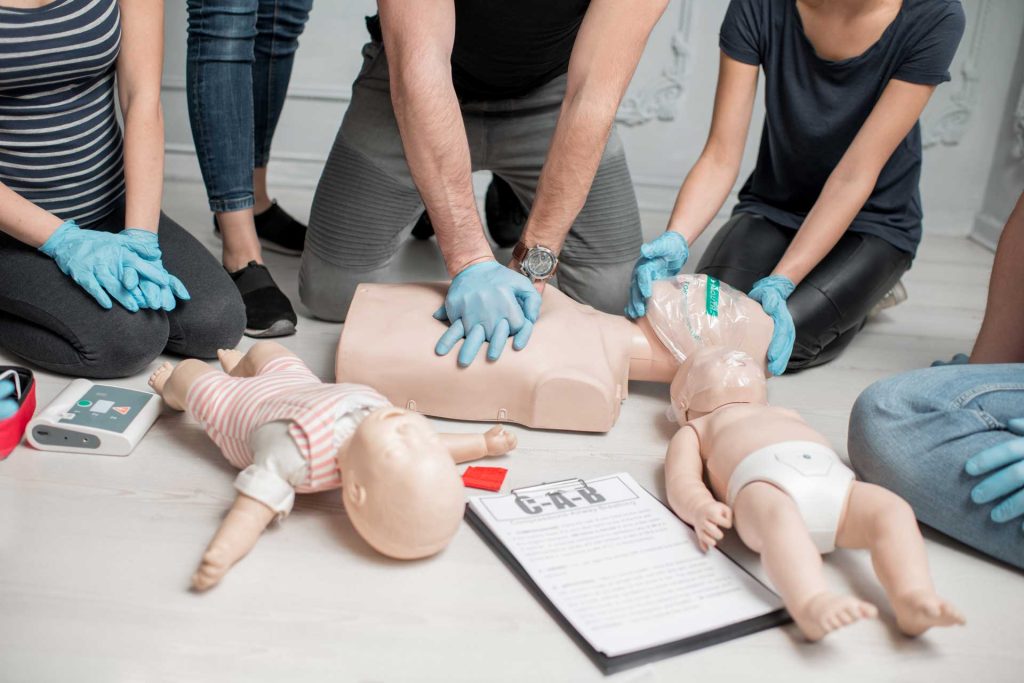
- Infant CPR, generally on a baby manikin, using two fingers for compressions and mild smokes for breaths. Child CPR, usually using 1 or 2 hands depending upon the child's size. How to adjust in between infant, kid and adult CPR if you care for a mixed‑age team, as in some clubs or vacation schemes. Using an AED securely on a child, consisting of correct pad positioning and when to utilize paediatric pads if available.
Express CPR courses that integrate adult and youngster abilities can function well if they offer adequate separate practice time on paediatric manikins. A fast CPR correspondence course, often taken by returning personnel, need to focus on restoring muscular tissue memory via repeated, practical technique rather than lengthy lectures.
What matters most is not that you keep in mind every fine detail six months later, yet that the course leaves you with a mental and physical picture you can recall swiftly when stress hits.
Choking: the scenario that takes place much too often
Child choking events are both common and distressing. Every early years or childcare expert I know contends least one story, whether it was a complete blockage, a near‑miss, or a kid that breathed in a little object.
Express child care first aid training has to go beyond "back impacts and upper body drives" as a formula. It should walk you through:
- The distinction between partial and full obstruction, and when to urge coughing versus intervene. How choking presents in babies who can not stand or talk. How to support the baby securely along your upper leg or lower arm to supply efficient impacts without injuring them. The series for abdominal embed older children, and why they are not used in little infants. What to do if a youngster faints while choking, and the web link between choking monitoring and CPR.
You must finish the first aid and CPR course having practised these activities repetitively, not just watched a demo. Many carers claim the choking drills are the solitary most valuable part of their express first aid courses.
Breathing troubles, asthma and anaphylaxis
In child care settings, troubles with breathing are extra constant than cardiac arrests by a huge margin. Bronchial asthma, viral wheeze, croup, extreme allergies and anxiousness can all existing as "having a hard time to breathe", but the feedbacks differ.

A well designed express child care first aid course educates you to identify red‑flag patterns, such as:
- A youngster speaking only in solitary words, or not able to speak. Obvious sucking in of the skin in between the ribs or at the base of the neck. Noisy breathing that suddenly comes to be quiet. Blue or grey tint around the lips or fingertips.
You should be comfortable aiding with suggested inhalers and spacers, and comprehend the standard distinction between a reducer (commonly a blue inhaler) and preventer medicines. For anaphylaxis, express first aid training must include practice with auto‑injector instructors, covering different brands and just how to manage once adrenaline is given.
The first aid certificate indicates little if, when confronted with a child whose breathing is plainly weakening, you wait because you have never ever actually held an auto‑injector in your own hands.
Injuries you are statistically more than likely to see
Express childcare first aid courses occasionally fixate on uncommon, remarkable events, while skimming past the things you will satisfy in real life, week after week. A well balanced course ought to address both.
From years of incident reporting in nurseries and colleges, a few patterns emerge.
Minor head injuries are extremely typical, as a result of falls from standing, reduced furniture, play area tools or rough play. The obstacle is working out which kids need urgent health center analysis and which can be securely observed. Training should cover warning signs such as repeated throwing up, unusual drowsiness, seizures, complication, getting worse migraine or behaviour that is plainly out of character.
Cuts and hemorrhaging take place frequently, specifically on faces, lips and scalps, which hemorrhage greater than a lot of carers expect. First aid training needs to help you judge when basic pressure and cleansing suffices, and when a child likely requirements stitches, adhesive or steri‑strips. It https://waylonwnsp250.theburnward.com/fast-first-aid-cpr-training-classes-what-to-expect must additionally resolve the useful problem of managing other youngsters in the space while one is hemorrhaging visibly.
Burns and scalds in child care commonly originate from hot drinks, radiators, cooking activities or outside tools on bright days. Every express first aid course must strengthen the relevance of very early, prolonged cooling with amazing running water, and the correct use dressings or cling movie. I have actually shed count of the amount of times I have actually seen well‑meaning team apply ice directly, butter, tooth paste or thick lotions, every one of which can make assessment and healing worse.
Sprains, thought cracks and joint injuries tend to follow falls or sporting activities tasks. The top priority is assistance, convenience, and protecting against more damages, plus documenting precisely what occurred and what was done next for moms and dads and healthcare professionals.
Good first aid and CPR training classes do not simply detail these injuries; they make use of real‑world instances, photos (sensitively picked), and scenarios attracted from childcare settings so that students recognise occurrences when they happen.
How express courses compress time without shedding quality
Fast first aid courses and express CPR training commonly increase an obvious Check over here concern: is it really possible to cover a lot in a shorter time?
The much better carriers make use of three main strategies.
First, combined knowing. Participants full theory material online in their own time prior to a shorter, securely focused practical session. This functions well for subjects like standard anatomy, simple definitions and legal obligations. The in‑person session can after that spend mostly all of its time on hands‑on CPR, choking drills, bandaging and situation work. When done correctly, an express first aid course can supply the same core abilities as a much longer standard course, with much less classroom sitting.
Second, concentrated, pertinent material. In child care, there is no requirement to spend half an hour on industrial crush injuries or chemical burns if those risks do not exist in your setting. A fast first aid training session that is clearly customized to baby rooms, clubs or institutions wastes far much less time than a generic office first aid course.
Third, limited group management. Little groups on each manikin, clear timings for drills, and trainers that keep up while still responding to inquiries. Express first aid training lives or passes away on how regimented the fitness instructors are with timing.
The warning is any kind of express childcare first aid course that urges everything can be carried out in, say, 90 minutes, including evaluation, certification and breaks, without any previous knowing. That is usually "fast certification" in the most awful sense, and it receives the confidence of the participants.
What a strong child care first aid session feels like on the day
People often ask what to anticipate from express childcare first aid training if they have only ever attended long, generic classes.
A typical combined express first aid course might appear like this:
Before the day, you full 1 to 3 hours of on the internet product. This covers basic first aid principles, lawful obligations, infection control, and an introduction to paediatric anatomy and common problems. Short quizzes inspect understanding, and you get here with some shared vocabulary.
On the day, the functional express first aid training runs for a number of hours. At an early stage, you get used to assessment regimens and safe methods, generally by going through numerous brief, basic scenarios. After that the fitness instructor moves into CPR and AED use, with plenty of time on infant and child manikins.
After a break, you concentrate on choking, taking a breath emergency situations, allergies and asthma. The trainer will usually revolve you through stations: choking drills at one, inhaler and spacer presentations at an additional, auto‑injector technique at a third.
The final part of the first aid and CPR course typically covers typical injuries, blood loss, burns and head injuries. Ideally, instructors relate this to your own setup. A nursery will certainly face different patterns of events than a senior high school sporting activities club. Time is alloted to clarify your guarding and reporting obligations after an incident.
Assessment is usually continuous instead of a challenging last examination. In many modern express first aid courses, instructors sign off abilities as they observe you performing them correctly.
When you leave, you should not feel like an emergency situation physician. You ought to feel able to start reliable first aid and to communicate plainly with parents and paramedics about what you have seen and done.
Picking a reliable training provider
Searching for a fast first aid course near me or express childcare first aid courses will return a lengthy listing of choices. Some are superb, some serve, and a few are bad enough that I would not want my very own youngster in the care of anyone they certificate.
A short list aids when you talk with companies:
- Are the trainers experienced with children, not simply with first aid? Ask whether they have actually worked in child care, institutions, paediatrics or emergency services. Is the course identified or certified by a reliable body in your region? Ask particularly which qualification you will certainly receive. How much time is hands‑on? If the majority of the day is lecture‑based, that is not optimal for an express course. How many participants per manikin and instructor? High proportions thin down practice and feedback. Does the content clearly match your setup? Nurseries, childminders, sports clubs and property care all need slightly various emphases.
For existing team, fast CPR correspondence course can be a useful means to keep skills sharp without shedding a full day. Simply guarantee that refresher courses still include real method, not simply enjoying a video.
Certificates, legal obligations and what they do not show
Most express child care first aid training results in a first aid certificate legitimate for a specified duration, usually one to three years. Companies not surprisingly concentrate on keeping these certificates in date. Regulators commonly insist on minimal varieties of personnel with existing first aid and CPR training classes.
There are, however, a couple of awkward realities that experienced trainers recognise.
The initially is that skill degeneration is genuine. CPR high quality and self-confidence in managing choking begin to go down within months for many individuals who hardly ever practice. That is why short, concentrated refreshers, also casual ones within a setting, can be so useful in between official courses.
The secondly is that a first aid certificate is evidence that the individual participated in and fulfilled the assessment standards at that point in time. It is not evidence that they will carry out perfectly under stress. Culture, management and normal drills within the childcare setting issue equally as much.
The third is that legal conformity and actual safety and security are not identical. You can technically meet necessary numbers of certified first aiders while placing them all on the exact same floor, or only on particular changes. Danger evaluations must affect the amount of team carry out first aid courses and where they are deployed.
When you purchase express childcare first aid training, deal with the certificate as the start of a process, not the end. Build method right into staff conferences, encourage individuals to share near‑misses, and treat every actual incident as a chance to evaluate and learn.
Simple actions to comply with in any type of childcare emergency
Despite the variety of circumstances express first aid courses cover, most childcare emergencies benefit from a basic, repeatable sequence.
Here is a functional structure that lines up with modern first aid and CPR training:
Pause and protect. Take one breath, check for danger, move dangers or relocate the kid if needed. Check feedback and breathing. Talk with the child, faucet delicately, look for regular breathing and movement. Call for help early. Scream for an associate, phone emergency services if major, and make certain a person notifies parents. Start the ideal standard treatment. This might be placing, stress on a wound, cooling a burn, aiding with medication, or CPR. Keep socializing. Guarantee the youngster, explain to spectators what is taking place, and turn over plainly to paramedics or parents.Express first aid and CPR courses exist to make those steps automatic. When team from the same nursery or club train with each other, they can likewise assign roles ahead of time. A single person leads care, one more takes care of the environment, a third takes care of communication and documentation. That synergy is what prevents chaos in a real emergency.
Final thoughts: what "good enough" truly means
No child care specialist should feel they should become a medical professional. Your duty in an emergency is to bridge the gap in between event and professional care, using uncomplicated first aid principles.
Well made express first aid courses and express childcare first aid training respect the constraints on your time while taking that function seriously. They concentrate on the situations you are most likely to encounter, they pierce the abilities that in fact conserve lives or avoid impairment, and they give you sufficient practice that your hands recognize what to do also when your heart is racing.
If you are accountable for preparing training, deal with generic, ultra‑quick first aid certification with care. Ask comprehensive questions, insist on paediatric‑specific material, and choose companies whose instructors plainly understand the truths of dealing with children.
If you are attending as a carer, enter prepared to practise, to ask uncomfortable concerns, and to relate each scenario to your own setting. A couple of focused hours of authentic express first aid training can make the difference in between panic and deliberate activity on the day you wish never comes.